

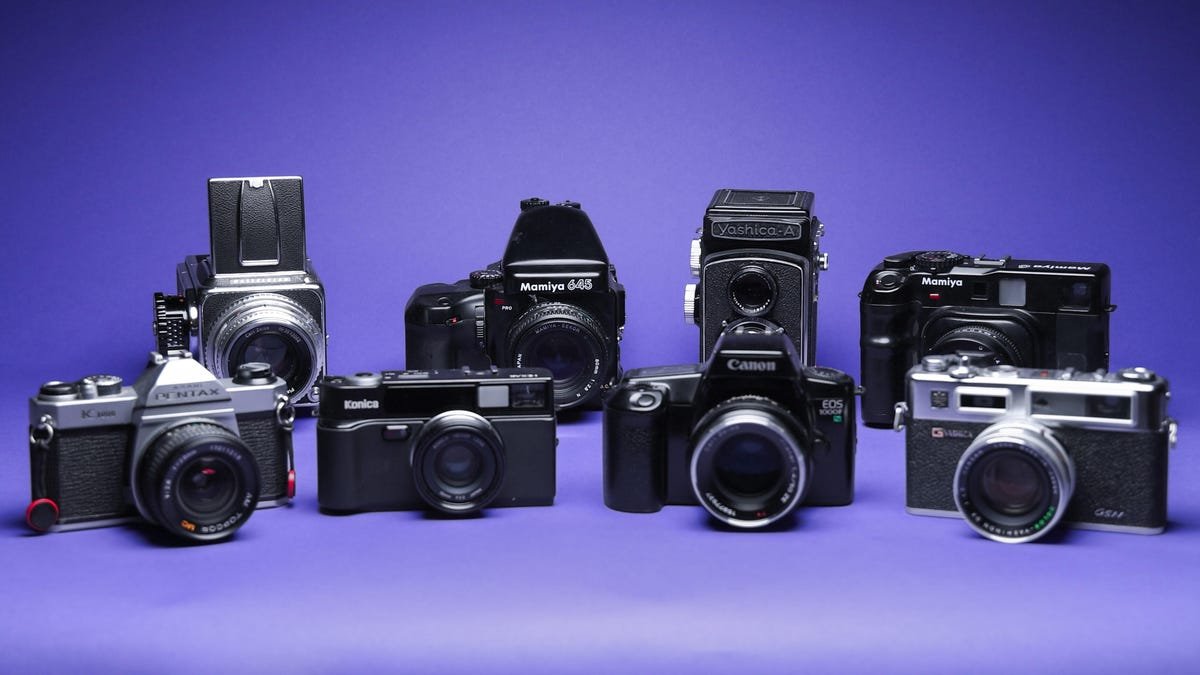
Digital cameras almost eradicated analog photography, but film is having a comeback, with analog cameras gaining popularity over the last couple of years. Film photography offers such a different experience from taking a photo with your phone or digital camera. It’s less about instant gratification and more about being in the moment and truly considering the image you want to capture. Aside from instant film, which is used in cameras like a Fuji Instax or a Polaroid, you also have to wait for your film to be developed and the images printed. It can be incredibly rewarding and a satisfying process, especially if you’re the one doing it all.
If you’ve never shot on film, it’s well worth trying, whether you’re a seasoned digital photographer or keen to take your first photos on a real camera instead of your phone. I’ve put together this guide to help you get started in film photography — from selecting the camera and choosing the right film through to where to buy both.
I’ve been a professional photographer for well over a decade, and while I grew up using digital cameras, I’ve thoroughly enjoyed diving into the world of film. So I’m going to share what I’ve learned.
Film has become increasingly popular on social media, thanks to its authentic retro look. I’m not immune to it either — I love the tones I can capture in film.
Many photographers have returned to film as a way to challenge themselves and seek authenticity in their images, while others simply like the old-school vibe in the same way that people collect and play vinyl records. For me, it’s all the above.
So let’s start in an obvious place: your camera.
The point-and-shoot Konica Hexar AF is extremely easy to use, and its high quality lens delivers sharp images.
Vintage SLR film cameras
Vintage SLRs, like the Canon AE1, Nikon F or the Pentax K1000, offer retro looks, which is never a bad thing, and were mass-produced across years; plenty are available, usually for not much money, as well as lenses and accessories. The Pentax K1000 I bought cost me the princely sum of 8 pounds (or around 10 bucks if you’re in the US). Better yet, older Pentax lenses are typically less expensive than their modern equivalents.
Some of these are fully manual cameras, so don’t expect autofocus, auto aperture or auto shutter speed. Instead, it usually has an internal light meter to tell you if you’re over- or underexposing your scene. (Just make sure to change out that battery for the light meter.) You can adjust the aperture and shutter speed accordingly until the needle is level.
Other models may have some auto modes, like aperture priority, that allow you to set the aperture on the lens and have the camera’s internal light meter select the shutter speed.
Having a built in light meter or auto settings can make it much easier to get the right exposure for your photos.
The lenses are also easier to get hold of. For example, Canon’s more recent EOS line of SLR cameras uses the same lens mount as its DSLRs before they moved to mirrorless. If you’re like me, you’ve shot with Canon’s digital cameras (such as the 60D or 5D MkIV), so you may already have a cupboard full of Canon EF-mount lenses that are compatible. If not, the huge selection available means they’re cheap and plentiful on the used market.
Most film cameras are 35mm — literally, the size of a frame of film. You can look at medium-format cameras that use 120 film, but they tend to be more complicated, more expensive and use more expensive film compared to 35mm shooters.
The Leica MP is one of the only film cameras still being produced. But it’ll cost you big.
Where should I buy film cameras from?
We all dream of finding a vintage Hasselblad or Leica going for a fiver in a junk shop, but the reality is that isn’t going to happen. So you actually need to pay some money.
Plenty of used cameras can be found online on eBay, Facebook Marketplace or Craigslist or even in just a flyer in your local camera shop. And maybe you’ve been tempted. Buying used this way can work out, as long as you know what you’re looking for; however, you must be cautious. Some people will sell nonworking equipment, and you may not realize it’s broken until you try and put film through it. And if you’re just buying from a guy on the street, you won’t have recourse if it turns out you’ve spent hundreds on a dud.
It was only after I put film in the Mamiya 645 that I found out it worked well. And this was one of the images I took with it.
Kamerastore provided all the cameras I tested for this article — excluding the Mamiya 645 and Pentax K1000, which I own — and I’ve really enjoyed using all of them while I’ve been putting this together. When I come to expanding my own collection, it will be Kamerastore that I’ll be spending with.
Now that you have your analog camera, you need something to put in it.
What is the best film to use in a camera?
Film fundamentally comes in two forms: color or black and white. Which one you should use comes down to personal preference. Typically, black and white is cheaper than color film, but neither form is exactly cheap these days.
A great standard color film is Kodak Gold 200. It gives a classic look that people love for its pleasing warm tones. It’s my favorite, as it happens, and at under $10 a roll, it’s also one of the cheapest, which makes it a great starter film for everyday use, as does its 200 ISO, which is suited for most daytime conditions.
Harman’s Phoenix II film has quite a strong look of its own, along with plenty of grain.
I’ve found that most online stores that sell film usually have a variety of example photos taken with each stock, so you can see the sort of tones you might get from it. And if you want to see more, simply Google the film and the handy keyword “examples” to find additional images to explore.
Buying film means making a decision on both the particular look you want and the types of photos you want to take with it. Why is that? Your film choice dictates your ISO speed — something that digital photographers are accustomed to adjusting with the push of a button. Most film has ISO somewhere in between 200 to 800.
Some films, like the black and white Leica Monopan 50, have an ISO speed of 50. That’s low sensitivity, so you’ll need slower shutter speeds and/or wider apertures to let in enough light, especially if you’re in dim surroundings. Ilford’s Delta 3200 black and white film, however, has a much faster ISO of 3200. You’ll be able to use faster shutter speeds, making it ideal for handheld shooting in low-light scenes. For black-and-white film, you can’t go wrong with Ilford HP5 for most scenarios or, for a cheaper alternative, Kentmere 400. They’re both solid, offer pleasing contrast and both have ISO speeds of 400.
I love the tones in this scene, from the warmer hues in the shadows to the vibrant greens of the ferns. Kodak Gold 200 is a great all-purpose color film.
Now that you have a camera, you’re ready to go. And you have your film. You’re doing well. Now it’s time to actually take some photos. Check back at CNET for my guide on how to shoot film photography on an analog camera.
(function() {
window.zdconsent = window.zdconsent || {run:[],cmd:[],useractioncomplete:[],analytics:[],functional:[],social:[]};
window.zdconsent.cmd = window.zdconsent.cmd || [];
window.zdconsent.cmd.push(function() {
!function(f,b,e,v,n,t,s)
{if(f.fbq)return;n=f.fbq=function(){n.callMethod?
n.callMethod.apply(n,arguments):n.queue.push(arguments)};
if(!f._fbq)f._fbq=n;n.push=n;n.loaded=!0;n.version=’2.0′;
n.queue=[];t=b.createElement(e);t.async=!0;
t.src=v;s=b.getElementsByTagName(e)[0];
s.parentNode.insertBefore(t,s)}(window, document,’script’,
‘https://connect.facebook.net/en_US/fbevents.js’);
fbq(‘set’, ‘autoConfig’, false, ‘789754228632403’);
fbq(‘init’, ‘789754228632403’);
});
})();